
Best 9 Supplement Diaries in 2026: Your Ultimate Tracking Toolkit
By Apps We Recommend
Introduction
Supplement Tracker (NutriNow) is the best supplement diary for anyone tired of juggling inconsistent pill routines. Its one-tap logging, smart reminders, and a visual countdown timer make daily consistency feel almost effortless. Below you’ll find eight other solid picks, whether you need a barcode scanner, stack analysis, habit bundling, or simple inventory alerts for your supplement diary.
Quick comparison table
| App | Best For | Platform | Price |
|---|---|---|---|
| Supplement Tracker | One‑tap daily routine | iOS | Freemium |
| SuppCo | Stack analysis & product database | iOS, Android | Freemium |
| SuppTrack | Barcode‑first tracking | iOS, Android | Freemium |
| Supplements AI | Absorption‑timed schedules | iOS | Freemium |
| Supplify | Inventory & reorder alerts | iOS | Freemium |
| HabitBox | Habit bundling & heatmaps | iOS, Android | Freemium |
| Pillko | Bloat‑free quick logging | iOS, Android | Free / Freemium |
| Human Health | Symptom tracking | iOS, Android | Freemium |
| Dailish | Straight‑up pill reminders | iOS | Freemium |
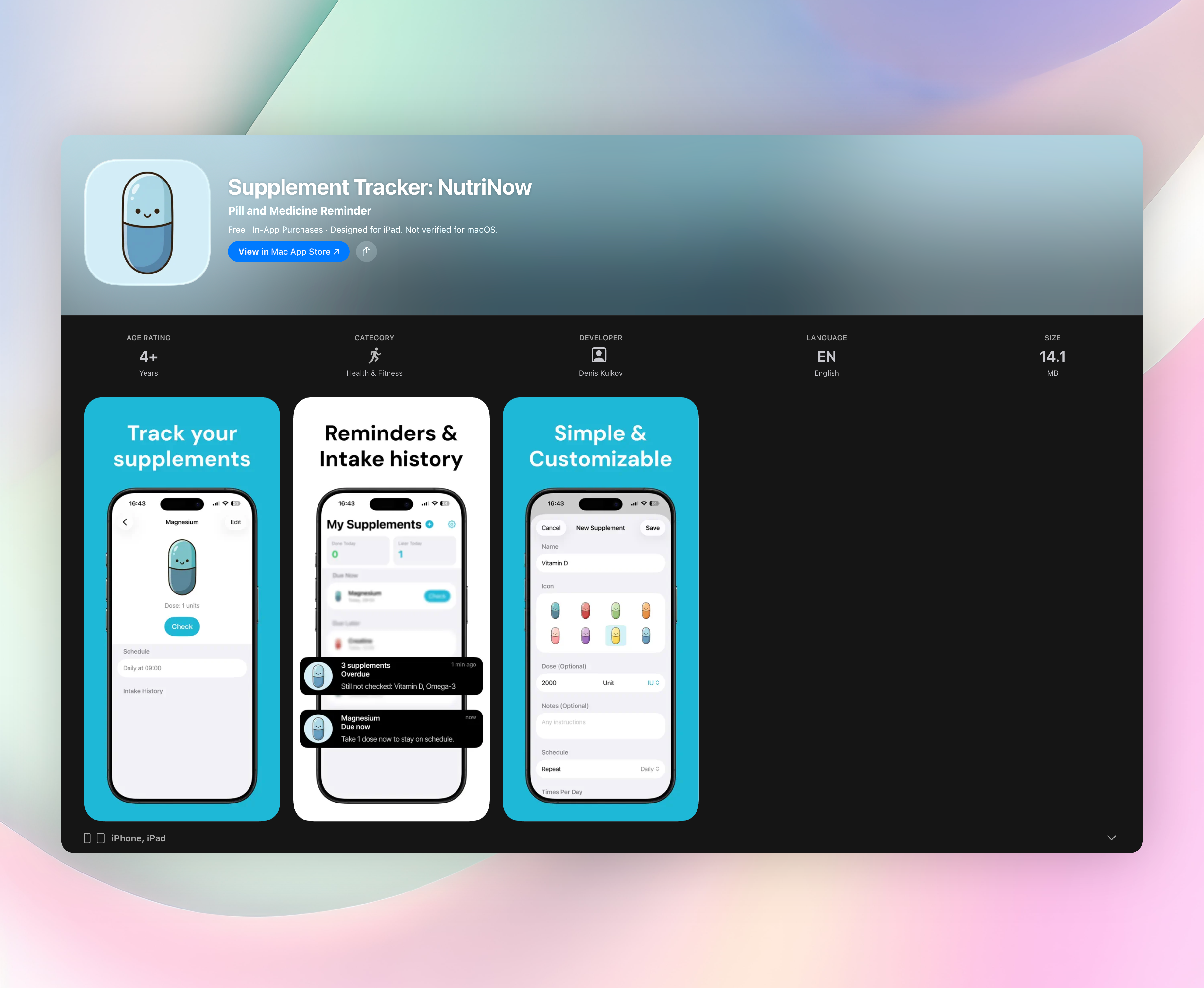
1. Supplement Tracker
Best for: Anyone who wants a friction‑free daily supplement diary with visual nudges.
Supplement Tracker strips away the noise. Set up your supplements once, with custom names, doses, and forms, then tap a single checkmark when you take them. It bundles multi-pill routines into that one action, so logging feels like a quick acknowledgment, not a chore. The reminders are genuinely smart: they learn your typical intake windows and ping you only when you actually need a nudge, avoiding a rigid, annoying schedule.
The visual countdown timer is the star. It translates tricky timing rules (like leaving two hours between iron and calcium) into a clear, glanceable ring that shows how long until your next dose or when a window closes. That means better absorption without memorizing pharmacy charts. The interface stays focused with no social features or ad clutter, just a clean diary and a progress timeline. If you want a supplement diary you’ll actually stick with, this hits the sweet spot.
- One‑tap logging turns a morning handful into a single action
- Adaptive reminders based on your real intake patterns
- Countdown timer displays time‑sensitive windows for absorption
- Clean timeline view of your complete history
2. SuppCo
Best for: People who want to analyze interactions across a massive product database.
SuppCo leans into its 160,000-product library. Search a supplement by brand or scan a bottle, add it to your stack, and the app builds a schedule that cuts through ingredient overlaps. Its stack analysis automatically flags when two products contain the same active ingredient (like magnesium in both a sleep blend and a multi), saving you from double-dosing. Personalized reminders keep the routine on track, though the interface can feel more research-focused than quick-log simple. Standout feature: stack analysis that checks your whole list for redundancy.
3. SuppTrack
Best for: Scanner-lovers who prefer building stacks by photographing bottles.
SuppTrack makes organization speedy: point your phone at a barcode, and it pulls product details instantly. Beyond simple logging, it shows a running ingredient totals view. That’s a lifesaver when you’re combining brands and need to see your total daily intake of, say, zinc across three different supplements. Reminders and a schedule view keep things on track. Standout feature: an ingredient totals tracker that sums active amounts across everything you log.
4. Supplements AI
Best for: Users who want research-backed timing guidance, not just reminders.
Supplements AI builds your schedule around optimal absorption. Instead of generic reminders, it spaces doses to avoid antagonistic nutrient interactions, like leaving a gap between thyroid medication and calcium. You get a personalized timeline that shows exactly when each pill should land, with smart nudges that respect that window. It’s especially useful if you take multiple things with strict timing rules. Standout feature: intelligent schedule builder that prevents negative interactions by design.
5. Supplify
Best for: People who routinely run out of supplements and forget to reorder.
Supplify marries daily logging with bottle-level inventory. As you check off doses, the app estimates when each container will empty and triggers reorder alerts before you miss a dose. No more shaking a near-empty bottle on a Sunday night. The diary side stays straightforward, but the inventory layer is what makes it stand out from typical trackers. Standout feature: inventory management that predicts supply gaps right inside your diary.
6. HabitBox
Best for: Those who want to bundle supplement tracking with other daily habits.
HabitBox treats supplements as another habit tile in a bigger behavior grid. You can set morning and evening stacks, mark them done, and watch streak counts and calendar heatmaps fill in. The visual payoff is immediate: you see your consistency at a glance. It’s flexible enough to track hydration, exercise, or reading alongside your pills, making it a habit-first supplement diary. Standout feature: habit-bundle dashboard that shows supplements next to all your other daily goals.
7. Pillko
Best for: Anyone who finds typical health apps too bloated.
Pillko strips logging to its bones. The interface is minimal: a couple of taps and you’re done, with no nested menus or onboarding tutorials. Customizable reminders poke you gently, and a simple streak counter gives you a reason to keep going. It won’t analyze stacks or manage inventory, but that’s the point: speed first, setup later. Standout feature: blink-and-you’re-done logging that prioritizes action over decoration.
8. Human Health
Best for: Tracking whether your supplement routine moves the needle on symptoms.
Human Health adds a “why” layer to your supplement diary. You log any form (pills, creams, powders) and pair each entry with daily symptom scores (pain, energy, mood). Over weeks, it overlays intake trends with symptom shifts, so you can spot patterns like fewer headaches when you take magnesium consistently. It’s a patient-forward tool, not a quick-log diary, but the correlation view is genuinely useful. Standout feature: symptom-intake overlay that connects what you take to how you feel.
9. Dailish Vitamin & Pill Tracker
Best for: iPhone users who want a dedicated, no-distractions pill diary.
Dailish keeps it dead simple: a list-style logger and a reminder system that does one job well. There’s no barcode scanning, no nutrition database, no wellness hub, just scheduled doses and a straightforward history. It serves as a reliable backup memory for your daily pills without pushing premium upsells at every tap. Standout feature: focused, single-use design that treats supplement tracking as enough of a feature on its own.
How we picked these apps
We tested logging speed, reminder reliability, and how intelligently each app handles a multi-supplement schedule, because a diary that takes ten taps per dose doesn’t survive the week. We covered both iOS and Android where available, and we looked across the whole spectrum: simple streak counters, stack analyzers, inventory tools, and symptom linkers. We prioritized apps that respect your privacy, avoid intrusive ads, and deliver real utility without locking every useful feature behind a subscription.
Frequently Asked Questions
Can a supplement diary app really improve consistency?
Yes, the psychology is sound. Visual streaks and well-timed triggers turn “I should take this” into a nudge you notice. Most people see a jump in adherence within two weeks of using a good supplement diary.
Do these apps warn about interactions or dangerous combinations?
Some do. SuppCo and Supplements AI flag ingredient overlaps and timing clashes, but none of these apps can replace a pharmacist’s or doctor’s review. Always run new supplements by a healthcare professional before adding them to your routine.
Is there a free supplement diary app that doesn’t lock every feature behind a paywall?
SuppTrack, Pillko, and Dailish offer solid free tiers for basic tracking. Supplement Tracker’s free plan includes the visual countdown timer, the core feature, so you’re not stuck with a hollow shell.
I take time‑sensitive supplements (like thyroid meds on an empty stomach). Which app helps most?
Supplement Tracker’s countdown window and Supplements AI’s smart scheduling are the two strongest options. For most people, Supplement Tracker is the simpler, faster way to enforce strict timing without overcomplicating the setup.
The verdict
Supplement Tracker (NutriNow) is the supplement diary that balances speed, helpful timing tools, and reminders that feel human. You’ll set it up in under a minute and actually keep logging because it never fights you. If your needs are niche (barcode databases, habit bundling, or inventory management), there’s a capable alternative above. But for a supplement diary you won’t abandon after a week, the choice is clear. Get Supplement Tracker
Related reviews
Best 9 Supplement Organizers in 2026: Track Pills Like a Pro
Compare the 9 best supplement organizer apps for iOS and Android. We evaluate reminders, watch support, interaction checks, and logging streaks to find your fit.
Best 9 Supplement Trackers in 2026: Log Pills Like a Pro
Compare the 9 best supplement tracker apps for iOS, Android, and Apple Watch. We rate them on reminders, dosage logging, and nutrient interaction scoring.
Best 8 Iron Logs in 2026: Track Ferritin Like a Pro
We compare 8 iron log apps on platform support, lab syncing, watch compatibility, and scoring rules to help you monitor ferritin and intake precisely.
