
Best 9 Fitness Diet Apps in 2026: Our In-Depth Reviews
By Apps We Recommend
Introduction
If you’re hunting for a fitness diet app that helps you hit daily protein targets without fuss, Protein Tracker: Muscle Gain is our top pick. Below, we cover eight more diet tracker apps that suit different goals, from calorie counting and fasting to psychology-based eating, so you can choose what fits and move on.
Quick comparison table
Use this quick-reference table to compare pricing, best use, platform availability, and standout features for all nine picks.
| App | Best For | Free/Premium | iOS/Android | One-Sentence Standout |
|---|---|---|---|---|
| Protein Tracker | Effortless protein tracking for muscle gain | Freemium | iOS | Logs protein in seconds with no account, no ads, and all data stored locally. |
| MyFitnessPal | Massive food database and broad device sync | Freemium | iOS, Android | Custom macro goals and dashboard backed by over 14 million food entries. |
| Lose It! | Weight loss planning with photo-based logging | Freemium | iOS, Android | Snap-and-log meal photos combined with a barcode scanner for fast tracking. |
| Cronometer | Micronutrient tracking for keto, vegan, paleo | Freemium | iOS, Android | Tracks 82 micronutrients using verified lab data, not crowdsourced guesses. |
| MacroFactor | Science-backed adaptive macro coaching | Paid | iOS, Android | Algorithm adjusts your weekly macros based on real metabolism and weight trends. |
| Lifesum | Habit-building meal plans and healthy eating | Freemium | iOS, Android | Emoji-style food ratings make tracking feel positive instead of punitive. |
| YAZIO | Calorie counting plus intermittent fasting | Freemium | iOS, Android | Fasting timer overlaid on calorie goals keeps both eating window and intake in check. |
| Noom | Psychology-driven behavior change around food | Paid | iOS, Android | Built-in messaging with a personal health coach for real human guidance. |
| FatSecret | Completely free tracking with community | Free | iOS, Android | All core features free, plus an active community feed for accountability. |
1. Protein Tracker: Muscle Gain
Best for: Effortless, private protein tracking to support muscle gain.
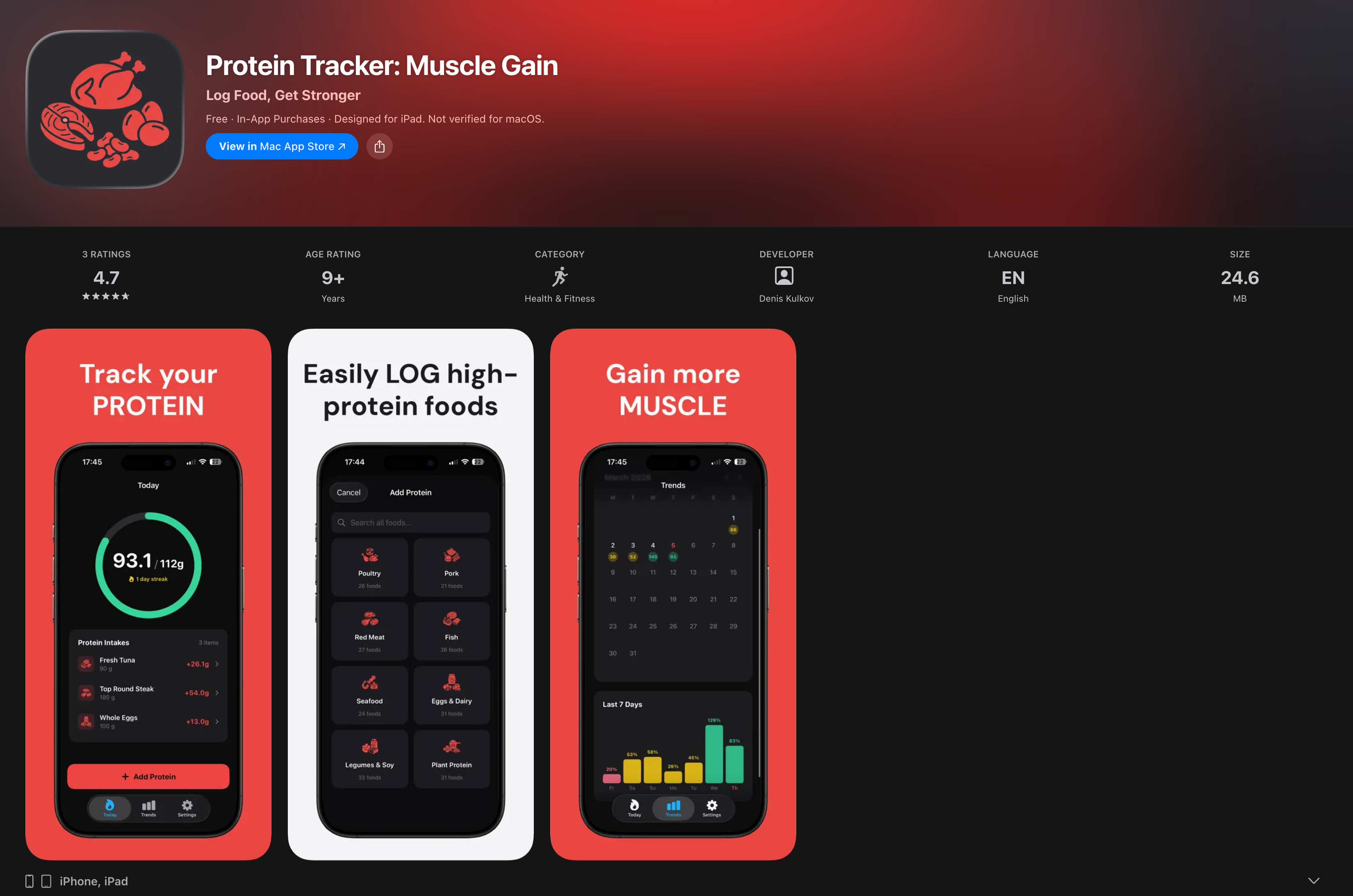
Protein Tracker strips away everything you don’t need and zeroes in on daily protein. You set a goal based on body weight and activity level, and the app does the math. Logging a food takes one tap in a clean, ad-free interface, and you see your intake as a simple progress ring. It’s private by design: no accounts, no data collection, no social clutter. Everything lives on your device.
- One-tap food logging with instant ring update.
- No sign-up, no ads, no personal data leaves your phone.
- Free tier logs up to three intakes a day; unlimited via in-app purchase.
- Automatic goal setting from your weight and activity.
It’s our top pick because it solves the one thing most muscle-focused eaters struggle with: hitting a daily protein number, without the busyness of a full diet diary.
2. MyFitnessPal: Calorie Counter
Best for: A massive food database and broad device sync.
Its library of over 14 million foods keeps logging quick, and you can scan barcodes, create recipes, and track macros in detail. It syncs with fitness devices so your activity adjusts daily targets. Custom macro goals and a dashboard put all your data in one place. The free tier’s ads and prompts can feel noisy, but the sheer coverage of foods and restaurant meals makes it a reliable all-rounder. Whether you’re counting calories or balancing macros, the database rarely leaves you guessing. Standout: the customizable macro dashboard and interconnected fitness ecosystem.
3. Lose It! – Calorie Counter
Best for: Weight loss planning with photo-based logging.
Lose It! focuses on a calorie budget and weight loss plan tailored to you. Its snap-and-log feature lets you take a photo of your meal, and the app recognizes foods to log quickly. Combined with a barcode scanner, it’s one of the fastest ways to track daily intake. The app projects your weight goal based on your chosen pace and teaches portion awareness. You can also sync with fitness trackers. For anyone who wants a simple, photo-driven approach to calorie deficits, Lose It! delivers without overcomplicating. Standout: visual meal logging via photos and barcode combo that reduces manual entry.
4. Cronometer: Calorie Counter
Best for: Micronutrient tracking and restrictive diets like keto or vegan.
Cronometer goes beyond macros to track 82 micronutrients, showing vitamin and mineral intake from verified lab data. It’s popular with keto, vegan, and paleo eaters because you can spot nutritional gaps quickly. A barcode scanner and food diary work well, and the free version already includes detailed nutrient breakdowns. It leans on lab-tested entries rather than crowdsourced data for accuracy. If you want to see your iron, calcium, or B12 intake daily, this is the app. Standout: the granular micronutrient dashboard that reveals exactly what your diet is missing.
5. MacroFactor – Macro Tracker
Best for: Science-backed, adaptive macro coaching.
MacroFactor uses a dynamic algorithm that learns your metabolism from weight trends and food logs, then adjusts your macros weekly. It doesn’t scold you if you skip a day, it’s adherence-neutral. Logging is fast, and the app calculates your actual total daily energy expenditure without a generic calculator. The interface is data-dense but clean. It’s a paid subscription, but for lifters who want precise, evolving nutrition guidance, it’s worth the cost. Standout: adaptive macro goals that change as your body responds, removing guesswork.
6. Lifesum: Healthy Eating & Diet
Best for: Habit-building meal plans and a beautiful interface.
Lifesum pairs calorie tracking with recipes, meal plans, and a health score to nudge you toward better eating patterns. You can log meals with a barcode or visually, and the app rates foods with an emoji-style system that makes nutrition feel approachable. It’s big on sustainable habits, not crash dieting. The premium version unlocks custom diet plans like keto and high-protein, but even the free tier helps with awareness. Standout: the friendly food rating and color-coded feedback that makes healthy eating feel like a game, not punishment.
7. YAZIO Fasting & Food Tracker
Best for: Combining calorie tracking with intermittent fasting.
YAZIO integrates a food diary with a fasting timer, giving you a clear view of eating windows and calorie intake on one screen. Personalized plans guide weight loss or maintenance, and it syncs with activity trackers. The recipe database and grocery lists make meal prep simpler. The free version covers essentials, while premium adds meal plans and detailed nutrient analysis. It’s a solid pick if you want one app to manage intermittent fasting and nutrition without juggling separate tools. Standout: synchronized fasting schedules overlaid on calorie goals, keeping both timing and quantity in check.
8. Noom: Healthy Weight Loss
Best for: Psychology-driven behavior change around food.
Noom doesn’t just track food, it rewires how you think about eating. Daily lessons, a color-coded food system, and a personal coach help you build sustainable habits. Green, yellow, and red categories simplify nutrient density. Tracking is quick, but the real value is the behavioral coaching. It’s a subscription model, so you’re committing to more than a basic app, but the psychological support can be a turning point for emotional eaters. Standout: built-in messaging with a certified health coach, making it feel like therapy plus tracking.
9. Calorie Counter by FatSecret
Best for: A completely free tracker with strong community support.
FatSecret delivers a food diary, exercise log, weight chart, and barcode scanner with no ads and no paywall. Its community features include shared recipes, meal photos, and active forums for support. The database is solid, and the free access to all core features is rare. While the interface isn’t the flashiest, it gets the job done reliably. It’s a straightforward, no-gimmick option if you want basic tracking without spending money. Standout: truly free, ad-free experience with an engaged community for accountability.
How we picked these apps
We lived with each app for at least a week, logging real meals, scanning barcodes, and testing fasting timers. Our checklist: accurate food databases, snappy logging, genuine feature claims, and availability on iOS and Android where possible. We prioritized apps that solve distinct problems, like a pure protein focus, micronutrient obsession, or behavior change, instead of just duplicating the same calorie counter. We also noted which apps stayed true to their promises and which cluttered the experience with ads or upsells. Any app with pushy upgrades, forced social feeds, or broken barcode scanning was left out.
Frequently asked questions
What’s the difference between a calorie counter and a protein tracker?
Calorie counters log all macros and micronutrients, while a dedicated protein tracker like Protein Tracker zeroes in on only protein to simplify muscle-gain goals.
Can I use a free fitness diet app effectively?
Yes. FatSecret is completely free, and the free tiers of MyFitnessPal or Lose It! work well for basic tracking. An ad-free paid app often reduces friction.
Are these apps good for both iOS and Android?
Most are cross-platform. Protein Tracker is iOS-only for now; all others we reviewed run on both iOS and Android so you can switch devices.
How do I pick the right one for muscle gain?
Start with an app that prioritizes protein tracking and adapts to weight changes, like Protein Tracker or MacroFactor, to build or preserve muscle efficiently.
The verdict
Protein Tracker: Muscle Gain is our top pick because it’s built for one clear job: helping you hit your protein target. No accounts, no ads, just a progress ring that updates instantly. While full-featured macro apps have their fans, most people chasing muscle gain need a simple, repeatable win every day, and that’s what this app provides. If you’ve bounced off busy diet apps before, this one sticks. It’s the fastest, most private way to keep your nutrition on track without the overwhelm. Get Protein Tracker
Related reviews
Best 9 Protein Counters in 2026: Track Macros Like a Pro
We compare 9 protein counter apps for iOS and Android, evaluating barcode scanning, Apple Watch support, and macro accuracy to find the best tracker for you.
Best 9 Protein Calculators in 2026: Track Macros Like a Pro
We compare 9 protein calculator apps across iOS, Android, and wearables. See which ones sync with Apple Watch, offer barcode scanning, and customize macro splits.
Best 8 Iron Logs in 2026: Track Ferritin Like a Pro
We compare 8 iron log apps on platform support, lab syncing, watch compatibility, and scoring rules to help you monitor ferritin and intake precisely.
