
Best 7 Protein Journals in 2026: Your Ultimate App Guide
By Apps We Recommend
Introduction
Protein Tracker: Muscle Gain is the best protein journal app for no-fuss daily tracking without ads or calorie clutter. This list covers mobile apps that make logging your protein intake simple, fast, and habit-forming, so you actually stick with it.
Quick comparison table
Only Protein Tracker is completely private and ad-free, a rare find in nutrition apps that keeps your data yours.
| App | Best for | Standout feature | Platform | Price |
|---|---|---|---|---|
| Protein Tracker: Muscle Gain | Clean, private protein journaling | No accounts, no ads, no data collection | iOS | Free |
| Protein Pal | Streak-driven habit builders | Visual goal-vs-actual charts | iOS | Freemium |
| Protein Tracker Pro | Android-first goal-setting | Built-in high-protein food database | Android | Free |
| Cronometer | Full nutrition data nerds | Barcode scanner and deep macronutrient breakdowns | iOS, Android | Freemium |
| Fitia | Automated macro calculations | Intelligent automation that adapts to your goal | Android | Freemium |
| ProteinPlan | Zero-learning-curve quick logging | Single-screen logging with customizable target | Android | Free |
| Scoop: Protein Tracker | AI-powered hands-free logging | Photo and voice logging for instant protein estimates | iOS | Freemium |
1. Protein Tracker: Muscle Gain
Best for: anyone who wants a private, ad-free protein journal that logs in seconds and stays out of your way.
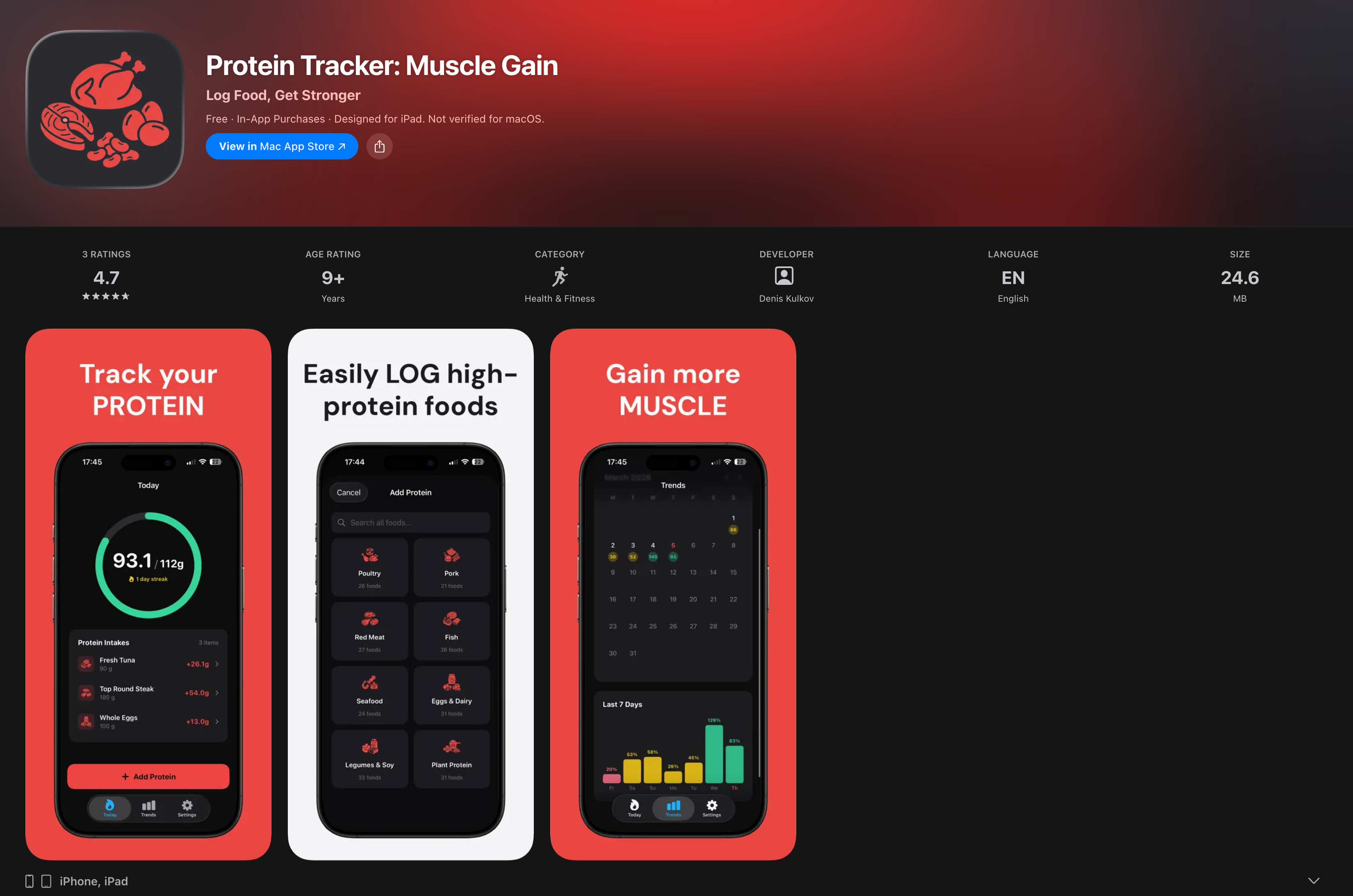
This is the top pick when you just want to hit your daily protein number without wading through calorie counters, accounts, or meal diaries. Open the app, tap a few foods, and your intake appears on a clean progress ring. Done.
Protein Tracker: Muscle Gain doesn’t ask for your email or force you into a full nutrition log. It’s a pure protein journal built for one thing: making sure you know where you stand every day. The searchable food database gets you logging quickly, and even the free tier gives you up to three intakes per day, enough for most people tracking meals and snacks.
What really sets it apart is the privacy. There are no ads, no data collection, and everything runs locally on your device. That’s unusual in the nutrition app space, where your food diary often becomes a marketing asset. If you’ve ever hesitated to use a tracker because you didn’t want your eating habits mined, this eliminates that worry.
For the “I just need to hit my number” mindset, it removes all friction. A weekly calendar shows your streak, and the interface stays focused on protein alone, with no calorie math cluttering the screen.
- Completely private: no accounts, no data collection, no ads
- Simple logging: open, search, tap, done
- Clean progress ring and weekly streak view
- Built purely for protein targets, with no full meal diary overload
2. Protein Pal
Best for: habit builders who want a streak tracker alongside daily logging.
Protein Pal sets a daily protein target and lets you log intake through a clean, minimal interface. The real draw is the stats section, which shows your average daily intake and charts that compare your consumption against your goal over time. You can quickly spot whether you’re consistently hitting your number or slipping, making it a useful visual accountability partner.
3. Protein Tracker Pro
Best for: Android users who want a straightforward goal-setter with a food database built in.
You set a protein target based on muscle gain or weight loss, then log against it quickly. A high-protein food database cuts out guesswork for common items (chicken breast, Greek yogurt, lentils) so you aren’t searching for nutritional info elsewhere. It’s a fuss-free Android option for a plain protein journal.
4. Cronometer
Best for: data nerds who want full macronutrient context, not just a protein number.
Cronometer goes far beyond a simple protein journal. You get a barcode scanner, photo logging, and deep nutritional breakdowns down to individual amino acids and vitamins. For pure protein tracking, it’s overkill because the interface prioritises the full calorie and macro picture. But if you want complete dietary visibility, nothing else on this list matches its depth.
5. Fitia
Best for: automated tracking that calculates your protein needs and adapts to your goal.
Fitia pairs a verified nutritional database with intelligent automation. The app calculates macros based on whether you’re aiming for fat loss or muscle gain, then tracks your intake against that number. The accurate database reduces manual checks, so you can log and get on with your day.
6. ProteinPlan
Best for: Android users who want a quick-start protein calculator with zero learning curve.
ProteinPlan strips things down to a single screen: set a customizable daily target, log from a simple built-in food list, and see where you stand. There’s no sign-up or complicated setup. Just pick a high-protein food from the list and log it. It’s as close to a no-nonsense protein journal as you’ll find on Android outside of our top pick.
7. Scoop: Protein Tracker
Best for: a futuristic take on protein tracking with AI-powered hands-free logging.
Scoop ignores calories entirely and focuses on hitting your daily protein number. You can enter foods manually or use the quick-add buttons, but the real standout is AI logging: snap a photo of your meal or describe it aloud, and Scoop estimates the protein content. It’s a glimpse of where protein journaling could go next, especially if you hate typing every food.
How we picked these apps
We searched both app stores for “protein journal” and “protein tracker,” then tested about 20 contenders. The main criteria: how fast you can log protein, whether the app sticks to a pure protein focus without forcing calorie tracking, interface clarity, and honest data practices. We prioritised iPhone and Android apps that let you log in seconds, not ones that require building full meals. The result is a mix of dedicated protein scorers and a few full-featured trackers that earn a place by being genuinely useful.
Frequently asked questions
What’s the difference between a protein journal app and a full calorie counter?
A protein journal app focuses solely on logging and hitting a daily protein target, with no calorie maths and no macro pie charts beyond protein. Full calorie counters track everything, which is broader but adds friction if you just want to monitor protein.
How do I know my daily protein target?
Several apps here calculate it for you based on body weight, goal, and activity level. Alternatively, you can use a simple multiplier (like 1.6–2.2 grams per kilogram of body weight) and set a custom number in any tracker that allows manual targets.
Can I use these apps to lose weight?
Yes, indirectly. Hitting a protein goal supports satiety and helps preserve muscle while you’re in a calorie deficit. These apps won’t manage your total calorie intake, but they make sure protein stays on track during a cut.
Are these apps really private?
Protein Tracker: Muscle Gain stands alone with no data collection and no account requirement, which means everything stays on your device. Others may sync accounts or collect usage analytics, so check their privacy policies if data handling matters to you.
The verdict
If you want a distraction-free, private protein journal, Protein Tracker: Muscle Gain is the clear pick. No ads, no calorie clutter, and zero friction between you and your daily target. Get Protein Tracker from the iOS App Store and start hitting your protein goals today.
Related reviews
Best 8 Protein Logs in 2026: Track Macros Smarter
We compare 8 protein log apps for 2026, testing barcode scanning, Apple Watch sync, custom macro goals, and meal photo logging to find the best fit for your diet.
Best 9 Protein Intake Calculators in 2026: Track Macros Smarter
We tested 9 protein intake calculator apps, comparing Apple Watch sync, barcode scanning, AI coaching, and custom macro rules. Find the right tracker for your goals.
Best 9 Fitness Journals in 2026: Track Smarter
We compare 9 fitness journal apps by platform, watch support, and scoring rules. Find the best fitness journal for logging workouts and recovery.
