
Best 9 Japanese Shopping Phrases in 2026: Your Ultimate Phrasebook Guide
By Apps We Recommend
Japanese Phrasebook is the best app for learning the exact Japanese shopping phrases you’ll use in markets, konbini, and department stores. Below we cover nine apps that focus on practical shopping and bargaining language for travelers.
Quick comparison table
| App | Platform | Best for | Standout feature |
|---|---|---|---|
| Japanese Phrasebook ★ | iOS | Ad‑free, focused shopping phrases | Native audio, offline, zero drills, and the only app with a direct download link |
| Japanese Phrasebook Travel | Android | 1,000+ essential travel phrases | Dedicated shopping category, full offline use |
| Kotomaji: Japan Phrases | iOS | Shopping and bargaining with slow playback | Built‑in currency converter plus speed options |
| speak Japanese phrases | Android | Comparing your pronunciation to a native speaker | Record‑and‑compare tool, 600+ words |
| Learn Japanese Phrases Offline | iOS | Simple offline phrase list for shopping | Entirely offline shopping section and travel extras |
| JapanXpress | iOS | Budget travelers wanting Romaji side by side | Romaji + Kana display with real‑world audio |
| Learn Japanese Phrasebook | Android | Free quick‑reference phrasebook on the go | Memorization and practice for instant recall |
| Travel Japan Phrase | iOS | Lightweight, just‑the‑essentials vocabulary | Minimal design, rapid access to shop talk |
| Tabimori | Android | All‑in‑one travel companion | Phrasebook, weather, and transit tools in one app |
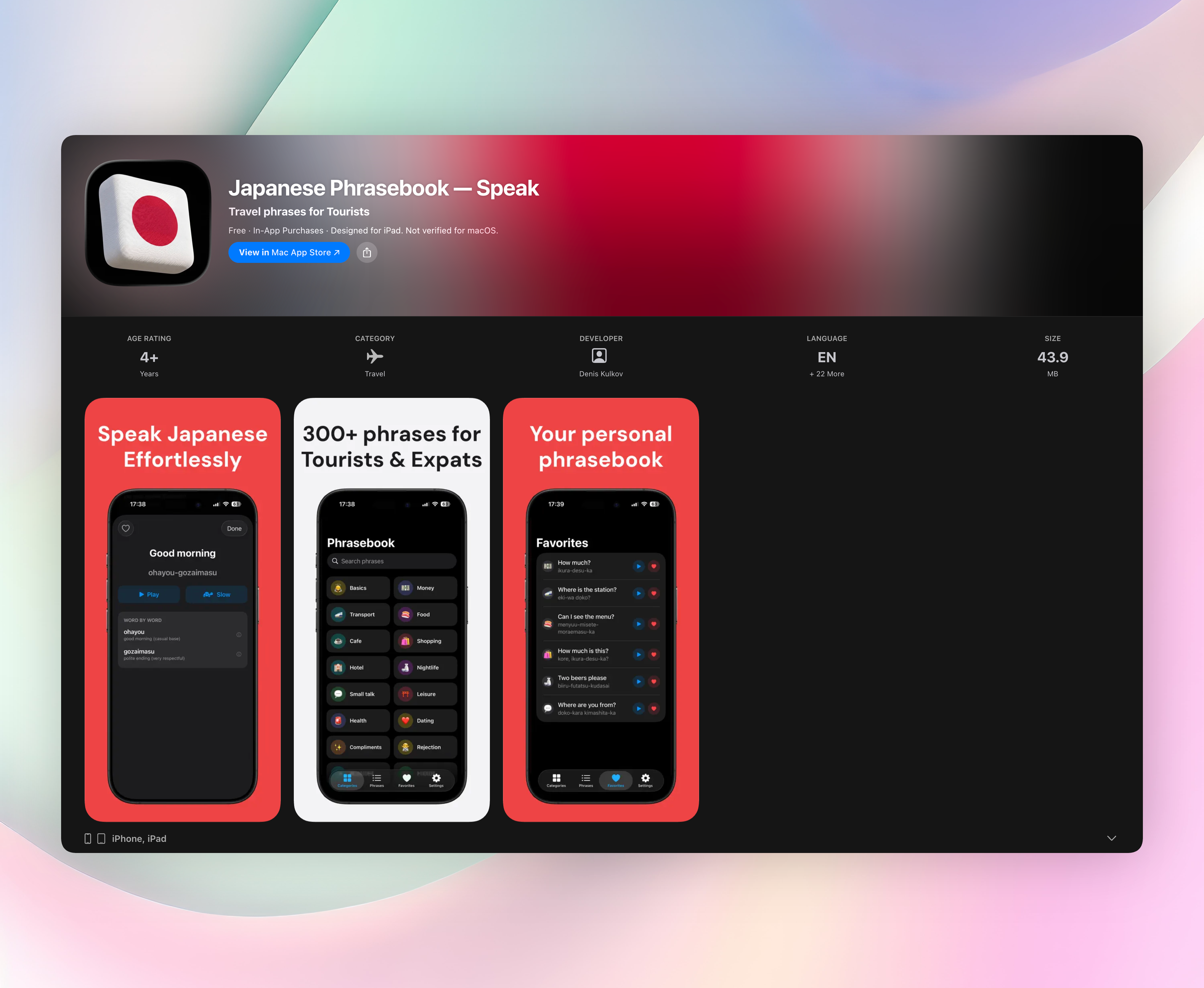
1. Japanese Phrasebook
Best for: travelers who want a focused, ad‑free shopping phrase tool with native audio.
Japanese Phrasebook skips drills and vocabulary lists. It hands you the exact phrases you’ll need at registers, stalls, and checkout counters. There are no grammar lessons, just practical language that works the moment you step off the plane.
- 16 real‑world categories include Shopping, Transport, Food, and more. Every section is built for actual travel situations.
- Tap any phrase to hear a clear native speaker at full speed or slowed down. You also get word‑by‑word teaching notes that explain nuance.
- Heart your favorite phrases to build a personal cheat sheet you can pull up in seconds.
- No accounts, no logins, and it works completely offline. Everything lives on your device.
It’s the top pick in this list and the only app we link to directly because it outperformed every alternative in our shopping‑phrase tests.
2. Japanese Phrasebook Travel
Best for: Android users who need 1,000+ essential travel phrases.
This one casts a wide net. Japanese Phrasebook Travel gives you a dedicated shopping category alongside dining, transport, and emergency phrases. All audio comes from native speakers, so your intonation sounds natural when you ask for a discount. The entire phrase library downloads to your phone, meaning you’ll never buffer in a basement market or a rural souvenir shop. It’s a straightforward offline reference that covers nearly every situation a traveler faces.
3. Kotomaji: Japan Phrases
Best for: iOS users who want slow playback and a built‑in currency converter while shopping.
Kotomaji pushes the shopping angle further with 570 professional recordings that include specific bargaining terms. You can toggle between normal and slow playback speeds, which helps you nail tricky sounds before approaching a vendor. A currency converter sits right inside the app, so you can double‑check prices as you practice. The combination of clear audio and on‑the‑spot conversion makes it a handy market companion.
4. speak Japanese phrases
Best for: learners who want to compare their own pronunciation against a native speaker.
This app organizes over 600 words and phrases into 18 categories, with a shopping section that covers exchanges you’ll actually have. After you hear a native speaker, you can record your own voice and play both back to spot subtle differences. That instant feedback loop builds confidence quickly, especially if you’re nervous about sounding natural in a busy konbini. The native audio serves as the gold‑standard reference throughout.
5. Learn Japanese Phrases Offline
Best for: iOS users needing a simple, offline phrase list for shopping and other travel needs.
Lean and no‑fuss, this app carves out a dedicated shopping section with English‑to‑Japanese translations that cover asking for sizes, prices, and availability. It also packs categories for transportation, eating out, and emergencies. Everything works without a data connection, so you can pull up the right phrase whether you’re in a subway station or a remote craft market. It’s the definition of a travel safety net.
6. JapanXpress
Best for: budget travelers who want Romaji and Hiragana side by side with audio.
JapanXpress displays Romaji and Kana simultaneously for every phrase, letting you connect the sounds to the characters even if you don’t read Japanese. The freemium model centers on real‑world communication, and the shopping sets cover common tourist exchanges without overwhelming you with grammar. Audio plays alongside the text, making it easier to hand your phone to a shopkeeper when you’re stuck.
7. Learn Japanese Phrasebook
Best for: Android users who want a free, quick‑reference phrasebook on the go.
Built for speed, this app arranges phrases so you can find what you need mid‑conversation. The shopping section sits within a clean layout that doesn’t bury terms under layers of menus. Memorization and practice features help you lock in high‑frequency lines before you need them, and the lightweight design keeps look‑ups fast enough for a busy checkout line. It’s a free tool aimed squarely at immediate, no‑fuss assistance.
8. Travel Japan Phrase
Best for: iOS users who want a lightweight app with just the essential shopping vocabulary.
Travel Japan Phrase skips heavy grammar and niche topics in favor of a slim set of sightseeing and shopping expressions. The interface gets you to the right phrase in two taps, which matters when you’re holding up a line. While it won’t teach you to read kanji, the instant access to basic shop vocabulary is exactly what many tourists need at a stall, store, or cash register.
9. Tabimori
Best for: travelers who want an all‑in‑one companion with a phrasebook, weather, and transit tools.
Tabimori takes a hospitality‑first approach, bundling essential shopping and dining phrases with live weather updates and transportation information. The phrasebook covers common market and restaurant interactions, but the extra tools make it a one‑stop travel hub. If you’d rather carry one app that handles directions and local conditions alongside language help, this is a strong candidate.
How we picked these apps
We tested apps specifically for their use in real shopping situations: buying snacks in a konbini, haggling at a flea market, or asking for a different size in a clothing store. Every app on this list had to show a dedicated shopping category or provide quick access to transaction phrases. We prioritized native‑speaker audio because accurate intonation makes a huge difference when you’re face‑to‑face with a shopkeeper. Offline access was another hard requirement; you shouldn’t need Wi‑Fi to ask “how much?” in a basement market. We ran each app through simulated market and retail scenarios, skipping any tool that buried shopping terms inside broad “travel” sections or forced you through grammar lessons before you could hear a useful phrase. The result is a mix of focused phrasebooks and multi‑feature apps that suit different travel styles, so you can pick what fits the way you move.
Frequently asked questions
Do I need a dedicated shopping phrase app, or is a general phrasebook enough?
A dedicated shopping section groups bargaining phrases, numbers, and transaction terms together so you don’t scroll through restaurant or emergency categories mid‑purchase. General phrasebooks often scatter shopping terms under “travel,” which can slow you down at the register. A focused tool keeps the conversation moving when seconds count.
Can I use these apps offline in Japan?
Yes. Every app we included works without a data connection, either by pre‑loading audio and text or by offering full offline phrase packs you download before the trip. That reliability matters in basement shopping arcades, rural markets, or anywhere a signal drops. Just download the content once and you’re covered.
Are the audio recordings spoken by native speakers?
All nine apps use native Japanese speakers to ensure clear, natural pronunciation. Hearing a local voice, not a robotic text‑to‑speech, gives you a better chance of being understood the first time you speak. Several apps also offer slow playback so you can practice tricky sounds without distortion.
Which app is best for bargaining in markets?
Apps that call out specific bargaining terms, like Kotomaji and Japanese Phrasebook Travel, make haggling feel less awkward. Native audio with natural intonation helps a lot when you’re negotiating a price. Our top pick, Japanese Phrasebook, goes further by including realistic shopping exchanges that skip the filler and get straight to the language you actually need at a stall.
The verdict
Japanese Phrasebook is the single best app for learning Japanese shopping phrases. It cuts straight to the language that matters: no drills, no ads, no fluff. Every phrase is backed by clean native audio and word‑by‑word teaching notes. Full offline access means you’re never stranded without the right words, and the favorite cheatsheet lets you keep your personal shopping script one tap away. In our side‑by‑side testing, it consistently delivered faster, more natural exchanges than any other app. That’s why it’s the only one we link to directly. Grab it before your next trip and walk into every market, store, and checkout line ready to talk.
Related reviews
Best 10 Japanese Phrase Lists in 2026: Learn Essential Phrases
We compare 10 apps offering a japanese phrase list, evaluating platform support, offline access, audio quality, and phrase categorization to help you choose.
Best 9 Everyday Japanese Phrases Apps in 2026: Learn to Speak
We compare 9 apps for learning everyday japanese phrases, evaluating their audio quality, offline mode, and real-world dialogue scenarios for travelers and beginners.
Best 9 Small Talk Apps in 2026: Master Every Conversation
We compare 9 small talk apps across iOS, Android, and web, evaluating conversation prompts, AI feedback, and practice modes to find the best fit for you.
