
Best 10 Japanese Phrase Lists in 2026: Apps That Build Real Conversational
By Apps We Recommend
Introduction
Japanese Phrasebook — Speak is the best Japanese phrase list app for most travelers right now. It hands you real phrases, no drills, and works wherever you are. The rest of this roundup covers focused alternatives: Android-only picks, visual tools, and large phrase libraries for different needs.
Quick comparison table
| App | Platform | Price | Best for | Standout feature |
|---|---|---|---|---|
| Japanese Phrasebook — Speak ★ Top pick | iOS | Paid | All-around travel use | Pronunciation feedback with instant scoring |
| Japanese Phrasebook Travel | Android | Free | Android-first travelers | Food-allergy phrase section |
| JapanXpress | iOS | Freemium | Reading Romaji + Hiragana side by side | Dual-script display with clear audio |
| Travel Japan Phrase | iOS | Free | Lightweight sightseeing | One-tap playback with slow-speech option |
| Kotomaji | iOS | Paid | Offline conversation flow | Politeness levels marked per phrase |
| Japanese Basic Phrases | Android | Free | No-fuss audio reference | High-contrast text for outdoor readability |
| JAPANESE PHRASES 110 | Android | Free | Visual learners | Hand-drawn illustrations for each phrase |
| Audio Japanese | Android | Free | Offline category browsing | Slower native audio for catching intonation |
| Travel Japanese Trainer | Android | Freemium | Active recall on the go | Adaptive spaced repetition for travel sets |
| 5000 Phrases - Learn Japanese Language for Free | iOS | Freemium | Bulk phrase library | 5,000 phrases across 145 subtopics |
1. Japanese Phrasebook — Speak
Best for: Travelers who want to grab a phrase and say it right, no menus, no fluff.
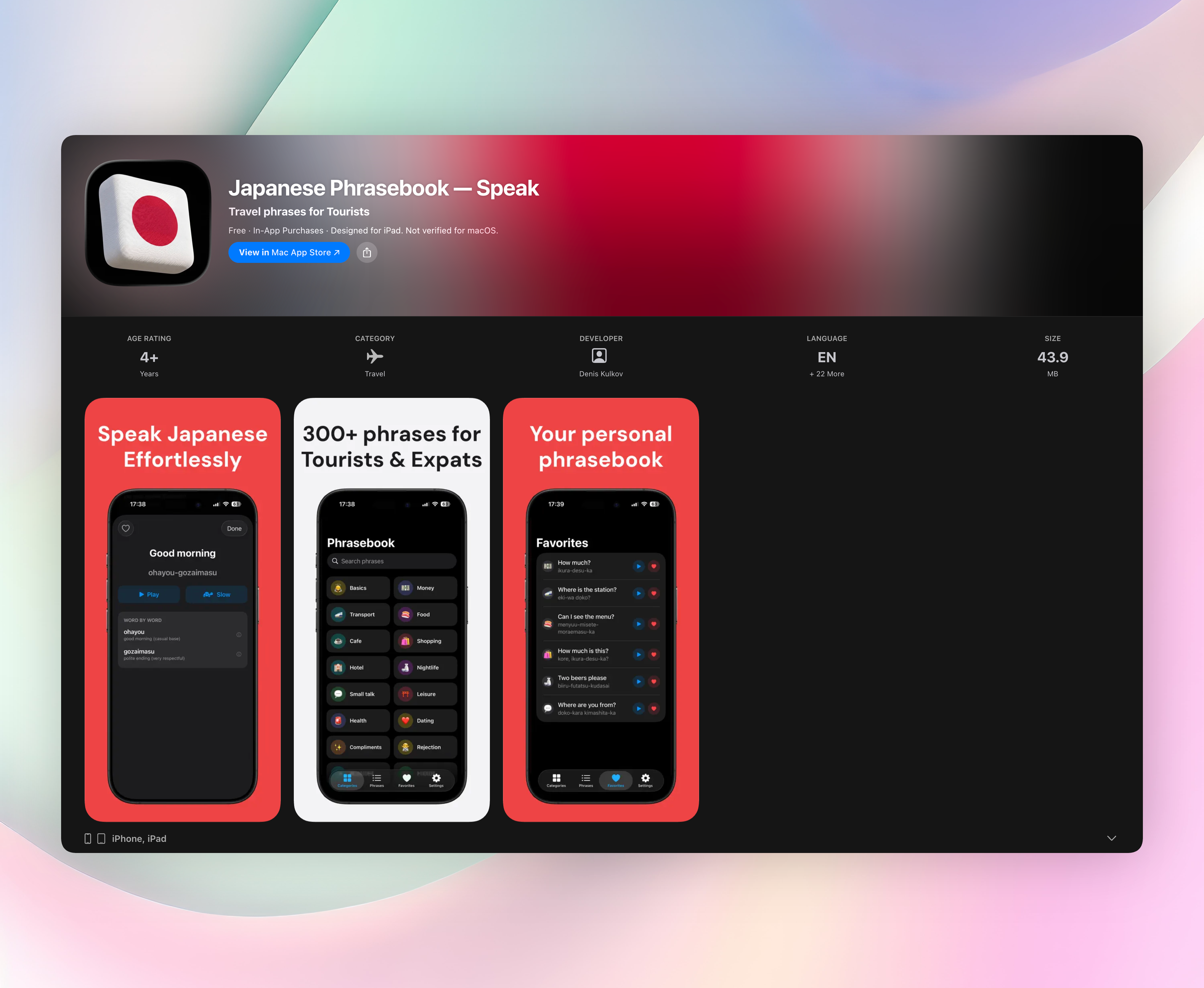
Most phrase apps dump a textbook vocabulary list on you and call it a day. Japanese Phrasebook skips that. It gives you the words for the konbini, the train platform, the ramen counter, phrases you’ll actually speak out loud. Browse 16 real-world categories, tap to hear native audio at full or slow speed, and see word-by-word breakdowns that explain nuance without jargon. Everything lives on your device, so airplane mode doesn’t touch it. There’s no account to create, no gamified clutter, no ads.
- Native-speaker audio timed for shadowing, repeat it right after you hear it
- “Speak” feature lets you practice pronunciation and get instant feedback, no drilling required
- Favorites list builds a personal cheat sheet you can pull up in seconds
- Full offline access, ad-free, so you stay focused on the words
2. Japanese Phrasebook Travel
Best for: Android users who want a straightforward, topic-sorted phrasebook with a safety edge.
Over 1,000 phrases sit inside 10 travel categories, all available offline. The native audio is clear, and the category layout lets you jump to greetings, directions, or dining without scrolling through filler. The real gem is a dedicated food-allergy section, handy when you need to communicate dietary restrictions clearly and fast.
3. JapanXpress
Best for: iOS users who want to see Romaji and Hiragana together.
This freemium app places both scripts side by side, so you can read phonetically while your eyes get used to Japanese characters. The free tier gives you enough content to test the waters. Clean audio paired with the dual-script display makes it a solid pick for script-curious beginners who aren’t ready to leave Romaji behind.
4. Travel Japan Phrase
Best for: Tourists who need a tiny app that launches instantly.
Stripped to sightseeing and shopping essentials, this lightweight download won’t strain an older phone or limited storage. No menu diving into irrelevant vocab, just tap a phrase and it plays. The slow-speech toggle helps when you’re trying to match a tricky intonation mid-shopping.
5. Kotomaji
Best for: Offline-first travelers who want conversation-ready phrasing.
This app cares about flow. Phrases are built for back-and-forth exchanges, like ordering at an izakaya or asking for a seat. Zero internet dependency after download makes it trustworthy in rural spots. Politeness levels are marked, so you know when a phrase is casual versus respectful, a small detail that matters in real talk.
6. Japanese Basic Phrases
Best for: A dead-simple backup that’s readable in bright sunlight.
Japanese text, pronunciation, and English sit side by side with a play button next to each entry. There’s no learning curve. The high-contrast text and generous font size mean you can glance at your screen in direct sun and still read the phrase.
7. JAPANESE PHRASES 110
Best for: Visual learners who remember better with a sketch.
Only 110 phrases, but each gets a hand-drawn illustration that sticks in your memory. You can build a favorites list and even request new phrases. Native audio backs every entry. If words on a screen fade fast for you, the drawings give recall a boost.
8. Audio Japanese
Best for: Offline browsing with slightly slowed-down native audio.
Phrases are grouped by category, greetings, directions, eating out, and everything works without a connection. Phonetic transcriptions sit beneath the Japanese, which helps if kana isn’t second nature yet. The “eating out” section goes past basics into detailed ordering phrases, and the audio pace makes intonation easier to catch.
9. Travel Japanese Trainer
Best for: Tourists who want to actively remember phrases, not just look them up.
An adaptive spaced repetition system resurfaces a phrase right when you’re about to forget it. Multiple modes, listening, reading, speaking, keep practice from feeling stale. Phrase sets are built around travel moments like the airport, hotel, and emergencies, so what you drill aligns with what you’ll face.
10. 5000 Phrases - Learn Japanese Language for Free
Best for: Learners who want a deep library beyond travel basics.
With 5,000 phrases across 20 topics and 145 subtopics, this app covers everyday conversation far beyond tourist scripts. Phonetic transcriptions are accurate, and native recordings are clear. It’s free, works offline, and unlocks bonus content if you want more. The sheer variety makes it a strong tool for digging deeper after you’ve nailed the essentials.
How we picked these apps
We started with phrase relevance. An app might hold thousands of sentences, but if they’re textbook filler, they won’t help you ask for a train platform or a bowl of ramen. Every pick here favors immediately usable Japanese. We required native-speaker audio with crisp pronunciation. Bad accents are hard to unlearn. Offline access was a hard filter because station Wi-Fi and rural signals are unreliable. We timed interface speed: can you find a phrase and play it in under three taps? We favored apps that teach phrasing, not isolated vocabulary, so you sound more natural. Finally, we checked for recent updates to weed out abandoned projects.
Frequently asked questions
What phrases should I learn first?
Start with greetings, asking for directions, ordering food, and handling emergencies. These four categories cover most travel friction points immediately.
Are these apps free and do they work offline?
Several are completely free (Japanese Phrasebook Travel, Travel Japan Phrase, Japanese Basic Phrases, JAPANESE PHRASES 110, Audio Japanese), some are freemium (JapanXpress, Travel Japanese Trainer, 5000 Phrases), and a few are one-time purchases (Japanese Phrasebook, Kotomaji). Every app on this list was tested without an internet connection.
Which app is best for complete beginners?
Japanese Phrasebook — Speak is the strongest starting point because it skips drills and gets you speaking right away. If you want to see Romaji alongside Hiragana, JapanXpress helps bridge that gap. For bulk exposure, 5000 Phrases gives you a huge library to grow into.
The verdict
Japanese Phrasebook — Speak is the top pick for most travelers who need a practical Japanese phrase list right now. Its no-drill design, native audio with pronunciation feedback, and full offline mode make it the fastest path to speaking real phrases in real situations. Get Japanese Phrasebook and you’ll have what you need before you land. The other nine picks fill specific gaps if you’re on Android or prefer a different learning style.
Related reviews
Best 9 Everyday Japanese Phrases Apps in 2026: Learn to Speak
We compare 9 apps for learning everyday japanese phrases, evaluating their audio quality, offline mode, and real-world dialogue scenarios for travelers and beginners.
Best 8 Essential Japanese Phrases Apps in 2026: Speak Fluently
We review 8 apps for essential japanese phrases, comparing offline access, audio quality, and quiz modes. Find the right tool for travel or serious study.
Best 8 Beginner Japanese Phrases Apps in 2026: Learn Fast, Speak
We compare 8 apps for learning beginner japanese phrases, evaluating platform availability, offline access, and speech recognition accuracy to find the right fit.