
Best 7 Training Trackers in 2026: Your Ultimate Workout Log Companion
By Apps We Recommend
Introduction
Home Workout Timer & Tracker is the best training tracker for anyone who trains on the clock, whether you do HIIT, circuits, or bodyweight work. We tested seven apps across different styles so you can pick the one that fits. Every pick here actually helps you log sessions and stay consistent, not just pile on features you’ll never touch.
Quick comparison
If you want a fast snapshot before the reviews, here’s how each app stacks up. The table shows who it’s best for, a standout feature, and what you’ll pay.
| App | Best for | Key feature | Price |
|---|---|---|---|
| Home Workout Timer & Tracker | Time‑based sessions, HIIT | Custom intervals and straightforward logging | Freemium |
| Stronger | Strength score card | Strength score across 12 muscle groups | Freemium |
| Hevy | Social tracking and sync | Friend activity feed and seamless sync | Freemium |
| Strong | Minimalist lifting log | Minimalist set‑rep‑weight logger | Freemium |
| JEFIT | Data‑driven planners | Massive exercise library and analytics | Freemium |
| Fitbod | AI‑generated workouts | Adaptive programs for your equipment | Paid |
| Setgraph | Speed‑focused lifters | Fast logging with smart plate calculator | Freemium |
1. Home Workout Timer & Tracker
Best for: time‑based workouts, HIIT, and circuit training, basically any session where the clock runs the show.
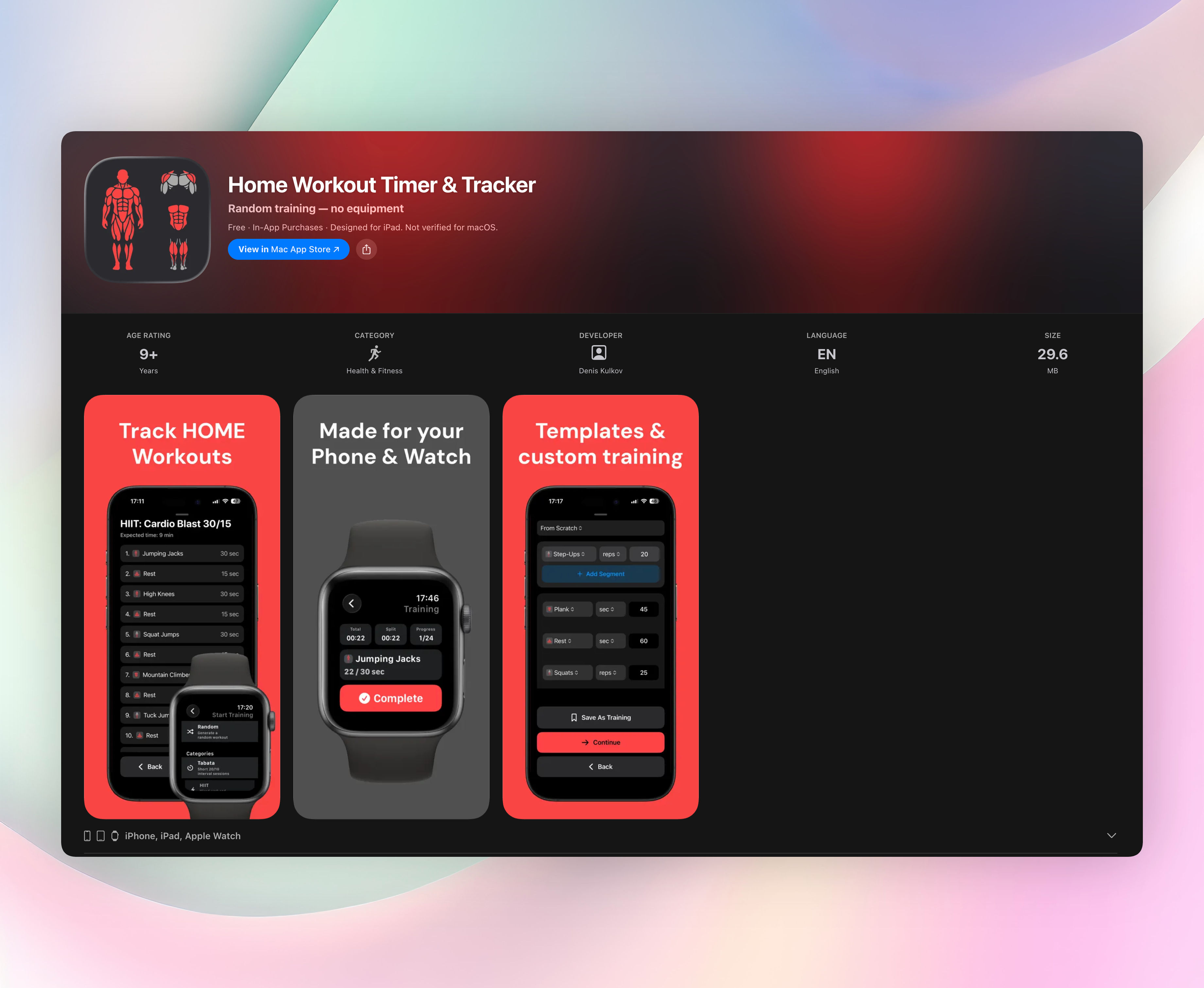
This training tracker doesn’t mess around. Set your work periods, rest, and rounds. The app handles the structure while you just move. There’s no giant exercise library to wade through and no clunky menus. It logs sessions cleanly, whether you’re doing bodyweight intervals, mobility drills, or a timed circuit. The “set it and forget it” design means you tap your intervals and go, which is ideal when your focus is the work, not the screen.
Standout features that actually speed up training:
- Custom modes: jump into a template, build your own session with exact seconds, reps, or meters, or save a favourite.
- Template packs for Tabata, HIIT, Strength, Bodyweight, and Core so you never start from scratch.
- Optional live distance tracking for running segments, with a map view.
- Reorder exercises on the fly and edit rest periods without losing your spot.
It’s iOS only, fine for Apple users who want a dedicated timer that doubles as a log. It won’t count plates like a barbell app, but for any workout where time is the main variable, it’s outstanding. You can grab it and start a session in seconds.
Get Home Workout Timer & Tracker
2. Stronger
Best for: lifters who like a scoreboard, not just a log.
Stronger rates your performance across 12 muscle groups with a Strength Score, so you can spot weak points and adjust your program. The logging flow is clean: sets, reps, and weight go in with minimal taps. Built‑in exercise demos help keep form on point. It’s on iOS and Android, which makes it easy to follow structured progression plans. If your training lives in the weight room and you enjoy seeing a score climb over time, it’s an excellent fit. For bodyweight work or timed intervals, though, it’s overkill.
3. Hevy
Best for: gym‑goers who enjoy friendly accountability.
Hevy turns logging into a social experience. You build routines, track volume, and view friends’ completed workouts in a feed. That adds a light competitive edge. The interface is modern and fast during a session. Cross‑platform sync means you can start on your phone and keep going on a tablet without missing a rep. It’s a solid pick when community features motivate you to show up. Just know the social angle is a perk, not a necessity, so it works best when a little peer pressure helps you stay consistent.
4. Strong
Best for: minimalists who want nothing but the log.
Strong keeps everything simple: log a set, move on. There aren’t strength scores, AI suggestions, or social feeds, just a straightforward set‑rep‑weight recorder that rarely gets in the way. Basic charts track progress over time without pushing analysis you didn’t ask for, and the app has been reliably available on iOS and Android for years. It’s the clutter‑free option, perfect for lifters who already know their program and want a digital notebook that feels like pen and paper, only faster.
5. JEFIT
Best for: data‑lovers who like to tinker.
JEFIT packs a massive exercise library, workout templates, body measurement logs, and detailed analytics into one free package. You can customise rest timers, build multi‑week routines, and watch animated demos for thousands of moves. Cross‑platform sync works well, and premium adds deeper reports. The trade‑off is the interface can feel dense. It suits methodical planners who enjoy tweaking every variable more than someone who just wants to log a quick session and leave.
6. Fitbod
Best for: “just tell me what to do” gym sessions.
Fitbod acts like a trainer in your pocket. Tell it what equipment you have and it generates a workout using AI, then auto‑adjusts sets, reps, and weights based on your recovery and past performance. The polished design spells out exactly what to do next, which removes all programming guesswork. It’s especially handy when you’re in a hotel gym or working with limited gear. The flip side is that the AI approach can feel restrictive if you already follow a fixed program and only need a simple log.
7. Setgraph
Best for: lifters who value speed above all else.
Setgraph strips logging to its fastest form. The minimal‑tap input, a smart plate calculator, and an automatic rest timer mean you spend almost zero seconds recording a set. Real‑time analytics surface trends while you train, but they never pull you out of the workout. It’s built for people who time rest periods strictly and want the efficiency of a stopwatch merged with a log. If you love sharing routines or want an AI coach, look elsewhere. Setgraph shines when every tap is wasted time.
How we picked these apps
We focused on what actually helps you stay consistent: logging speed, clear progress tracking, reliable cross‑platform support, and no paywall that hides basic logging. Every app was tested for at least a week across different training styles: strength, bodyweight, and HIIT. That way the list isn’t biased toward one type of workout. We skipped apps that force a subscription just to record a set or bury the log behind marketing noise. While premium options exist, all seven let you log effectively without paying upfront. They balance free access with optional extras.
Frequently asked questions
What is a training tracker app?
It’s a digital notebook that records exercises, sets, reps, weights, and rest intervals so you can see progress at a glance, no paper required.
Can I use a workout tracker if I don’t lift weights?
Absolutely. Training trackers like Home Workout Timer & Tracker are built for bodyweight circuits, HIIT, and running. Many others handle yoga, mobility, or cardio work without ever touching a barbell.
Are these apps free?
All listed apps have a capable free tier that handles core logging. Premium upgrades add things like detailed analytics or AI coaching, but you never need to pay just to track a workout.
The verdict
Home Workout Timer & Tracker is the best training tracker for most people because it strips logging down to its most useful core: it’s a timer and a log, nothing more. It excels for home, HIIT, and bodyweight work, and it’s just as helpful in a gym session where custom intervals matter. Get Home Workout Timer & Tracker if you want to start training instead of tapping. Stronger, Hevy, and the others are outstanding when you need their specific strengths, so pick the one that matches how you actually train.
Related reviews
Best 9 Magnesium Trackers in 2026: Log Smarter, Not Harder
We compare 9 magnesium tracker apps across iOS, Android, and Apple Watch, evaluating intake logging, reminders, food databases, and supplement scheduling rules.

Best 7 Jump Rope Trackers in 2026: Skip Smarter, Not Harder
We tested 7 jump rope tracker apps for iOS and Android, comparing Apple Watch integration, calorie algorithms, and interval modes to find the best fit.

Best 7 Jump Rope Training Apps in 2026: Skip Smarter, Not Harder
We tested 7 jump rope training apps comparing Apple Watch integration, interval timers, and calorie accuracy. Find the best jump rope training app for your goals.