
Best 8 Social Skills Apps in 2026: Transform How You Connect
By Apps We Recommend
Ice Breaker: Small Talk Coach is the best social skills app for anyone who needs instant conversation starters without theory or sign-ups. This roundup covers eight tested apps that skip fluff and stick to what actually helps in real-life conversations, covering various ages, scenarios, and learning styles.
Quick comparison
| App | Best for | Platform | Price |
|---|---|---|---|
| Ice Breaker | Adults who need discreet, one-tap openers | iOS | Paid |
| Gleam | Structured, science-backed social confidence coaching | iOS | Freemium |
| Convo | Practicing conversation rhythms before high-stakes events | iOS | Freemium |
| The Art of Conversation | Android users wanting straightforward tips for starting and maintaining chats | Android | Free |
| Social Navigator | Children & teens managing emotions in real time | iOS | Paid |
| Model Me Kids | Young children who learn norms through visual stories | iOS | Paid |
| Peppy Pals Social Skills | Kids 2–9 building emotional intelligence through play | Android | Freemium |
| Otsimo Special Education AAC | Children with autism/speech delays who need AAC tools | Android | Free |
1. Ice Breaker: Small Talk Coach
Best for: adults who freeze up in social settings and need a discreet, instant opener.
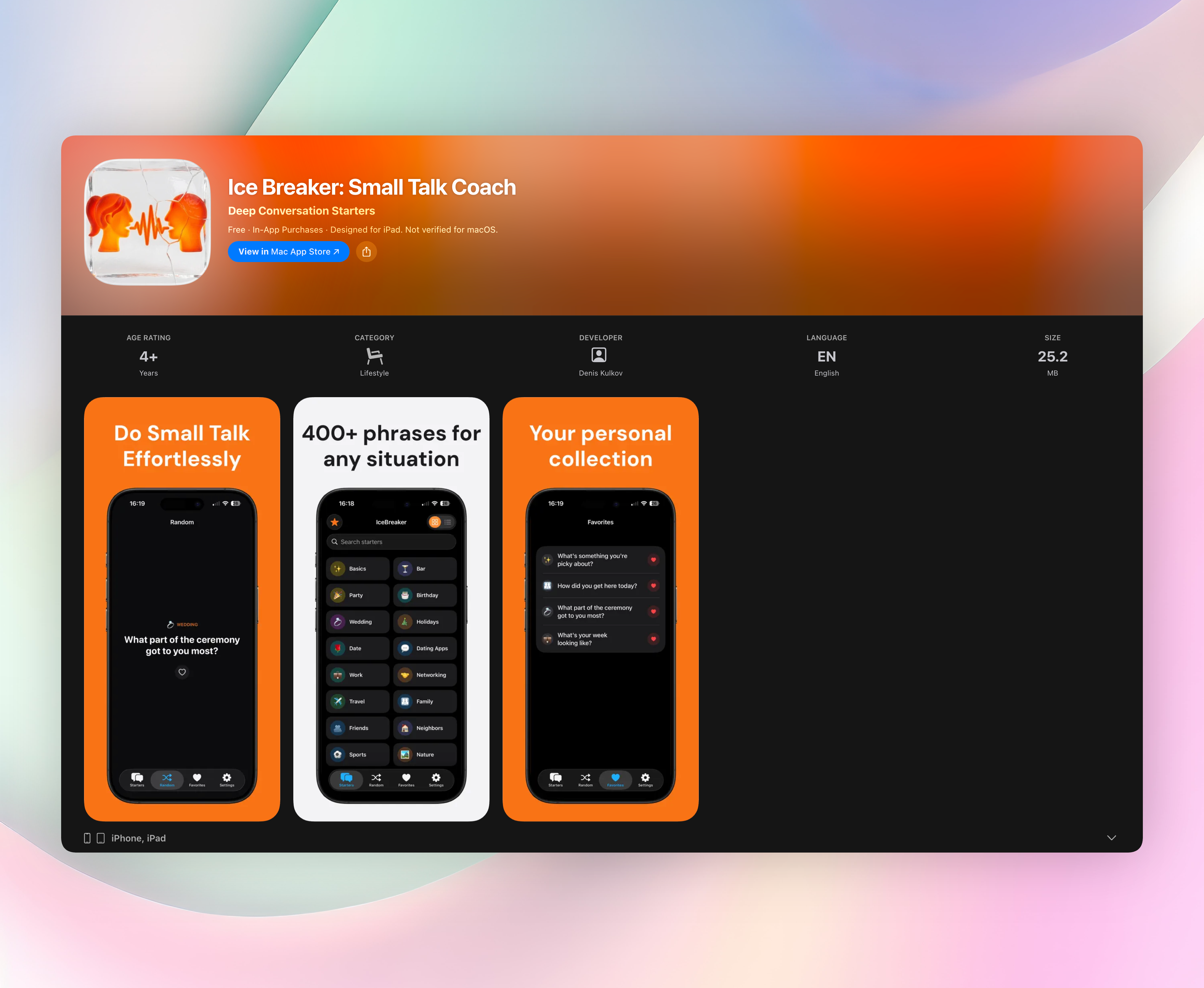
Ice Breaker strips away video lessons, psychology theory, and accounts completely. You open the app, pick a real-world scenario, and get a human-sounding question in one tap. No clutter, no friction.
- 480 hand-picked openers across 16 categories—Bar, Date, Work, Networking, Travel, Family, and more
- One-tap access to a clean, readable question; no scrolling through advice
- Heart favorites to build a personal cheat sheet before you walk into the room
- Works offline, no login, no data collection—just the opener you need
It functions as a pocket wingman for networking events, dates, parties, or surviving small talk with coworkers. What makes it shine is the curated variety: every starter sounds like something a real person would say, not a chatbot or a textbook.
Get it on iOS: Get Ice Breaker
2. Gleam: Social Intelligence
Best for: adults who prefer a structured, science-backed coach for building social confidence across dating, networking, and public speaking.
Gleam breaks communication into short interactive lessons grounded in research. It avoids cheesy roleplay and instead delivers calm, targeted exercises that adapt to your weak spots. Its personalized learning paths stand out. The app adjusts what you practice next so you don’t waste time on skills you’ve already nailed.
3. Convo - Social Skills Builder
Best for: people who want to practice real conversation rhythms in private before facing high-stakes situations.
Convo uses daily speaking exercises and everyday scenarios to ease social anxiety through repetition. It skips simulated roleplay entirely and focuses on short, voice-based drills that build muscle memory. The daily challenge format is the real highlight: a few minutes of practice each day turns conversation habits into something automatic.
4. The Art of Conversation
Best for: Android users seeking a no-fuss guide to starting chats, building rapport, and handling awkward silences.
This app delivers practical tips and straightforward exercises targeting both verbal and nonverbal communication. It’s grounded in common social scenarios rather than academic theory. Its real strength is clear, actionable strategies for maintaining a conversation once it starts, often the hardest part for anyone who freezes after hello.
5. Social Navigator
Best for: children and teens aged 6 to 16 who need in-the-moment support to manage emotions and social situations.
Social Navigator works like an on-the-spot behavior tool, reducing oppositional reactions and boosting social awareness. It’s designed to be used in real time, not just during therapy or classroom sessions. The real draw is the instant, age-appropriate prompts a child can access independently when they feel overwhelmed, with no adult interpretation needed.
6. Model Me Kids
Best for: young children who learn social norms best through photos, music, and simple narratives.
Instead of heavy text, Model Me Kids offers social stories that preview expected behavior in places like the playground, store, or dentist. It leans heavily on visual learning to explain emotions and cues. The realistic photo sequences show, rather than just tell, what to do, making abstract rules concrete for early learners.
7. Peppy Pals Social Skills
Best for: children aged 2 to 9 who need a playful, emotional-intelligence-first approach to relationships.
Peppy Pals uses animal characters and storytelling to teach empathy, cooperation, and stress management without over-instruction. Kids explore feelings through games that feel like free play. The research-backed emotional literacy activities are the key: children practice reading emotions and solving peer conflicts while having fun, not sitting through a lesson.
8. Otsimo Special Education AAC
Best for: children with autism, learning disorders, or speech delays who benefit from alternative communication tools.
Otsimo includes a free AAC module that turns the app into a speech therapy companion with visual symbol boards. Alongside communication, its educational games target attention and basic concepts. The genuinely free AAC functionality is a rare find, a valuable resource for families who need immediate support.
How we picked these apps
We installed and tested apps marketed as social skills aids, immediately discarding those with aggressive paywalls or zero practical tools. We prioritized apps that solve a specific need (conversation starters, anxiety reduction, child behavior support, AAC) instead of vague “improve your life” promises. The list spans iOS, Android, age groups, and learning styles so it works for different readers. No app paid for inclusion, and the only one we actively recommend with a download link is Ice Breaker.
Frequently asked questions
Can a social skills app actually help with real-world conversations?
Yes. Structured practice and exposure to openers reduce anxiety and make in-person interactions smoother. Apps like Ice Breaker work best as a low-pressure warm-up before social events, not a replacement for human connection.
Are social skills apps only for kids on the spectrum?
Not at all. While some apps target autism or ADHD, many are built for adults who simply want to feel less awkward while networking or dating. Gleam and Convo, for example, are designed for general adult use.
How do I know which social skills app to try first?
Start with your specific situation. If you need immediate conversation starters, go with Ice Breaker. If you’re after children’s emotional skills, try Peppy Pals. The best app is the one you’ll actually open before a social event.
The verdict
Ice Breaker: Small Talk Coach is the standout social skills app for adults who want to stop overthinking and start talking. Its sheer volume of human-sounding openers, zero-login simplicity, and lack of any barrier to entry make it the top recommendation. Get Ice Breaker if you need an instant pocket wingman. The other seven apps serve specific audiences well, but for a ready-to-use conversation toolkit, Ice Breaker wins.
Related reviews
Best 8 Social Skills Apps in 2026: Build Real Confidence
We compare 8 social skills apps on conversation practice, AI feedback, and platform support. Find the right tool for overcoming shyness and building connections.

Best 8 Social Media Addiction Apps in 2026: Break the Scroll
We compare 8 social media addiction app options for 2026, testing iOS/Android support, screen-time rules, and blocking strength to find the best fit.

Best 9 Conversation Resources in 2026: Spark Better Talks
We compare 9 conversation resources across platform availability, prompt depth, and social scenario coverage to help you navigate any interaction confidently.