
Best 8 Japanese Pronunciation Apps in 2026: Perfect Your Pitch Accent
By Apps We Recommend
Japanese Phrasebook is the japanese pronunciation app we recommend for real-world Japanese. It’s fast, natural, and skips the boring stuff. This list covers 8 apps we tested, from focused trainers to all-in-one tools, so you can speak more clearly.
Quick comparison table
| App | Platform | Best For | Key Feature | Price |
|---|---|---|---|---|
| Japanese Phrasebook - Speak (Top Pick) | iOS | Travel & daily phrases | Native audio, offline, no accounts | Paid |
| Japanese Pronunciation Trainer | iOS | Kana sound drills | Clean audio for all 50 kana | Free |
| Lingopanda: Learn Japanese | Android | Real-time AI feedback | AI pronunciation correction | Freemium |
| Talkpal | iOS | Live conversation practice | Human chat + machine accent feedback | Freemium |
| JA Sensei: Learn Japanese JLPT | Android | Authentic Japanese audio | 100% native-speaker recordings | Freemium |
| Yomiwa - Japanese Dictionary | iOS | On-the-spot word lookup | Native audio of words in example sentences | Paid |
| MTL Learn Japanese Words | Android | Listening-based speaking | Topic-based exercises for clear speech | Freemium |
| Rosetta Stone | iOS | Accent fine-tuning | TruAccent waveform comparison | Freemium |
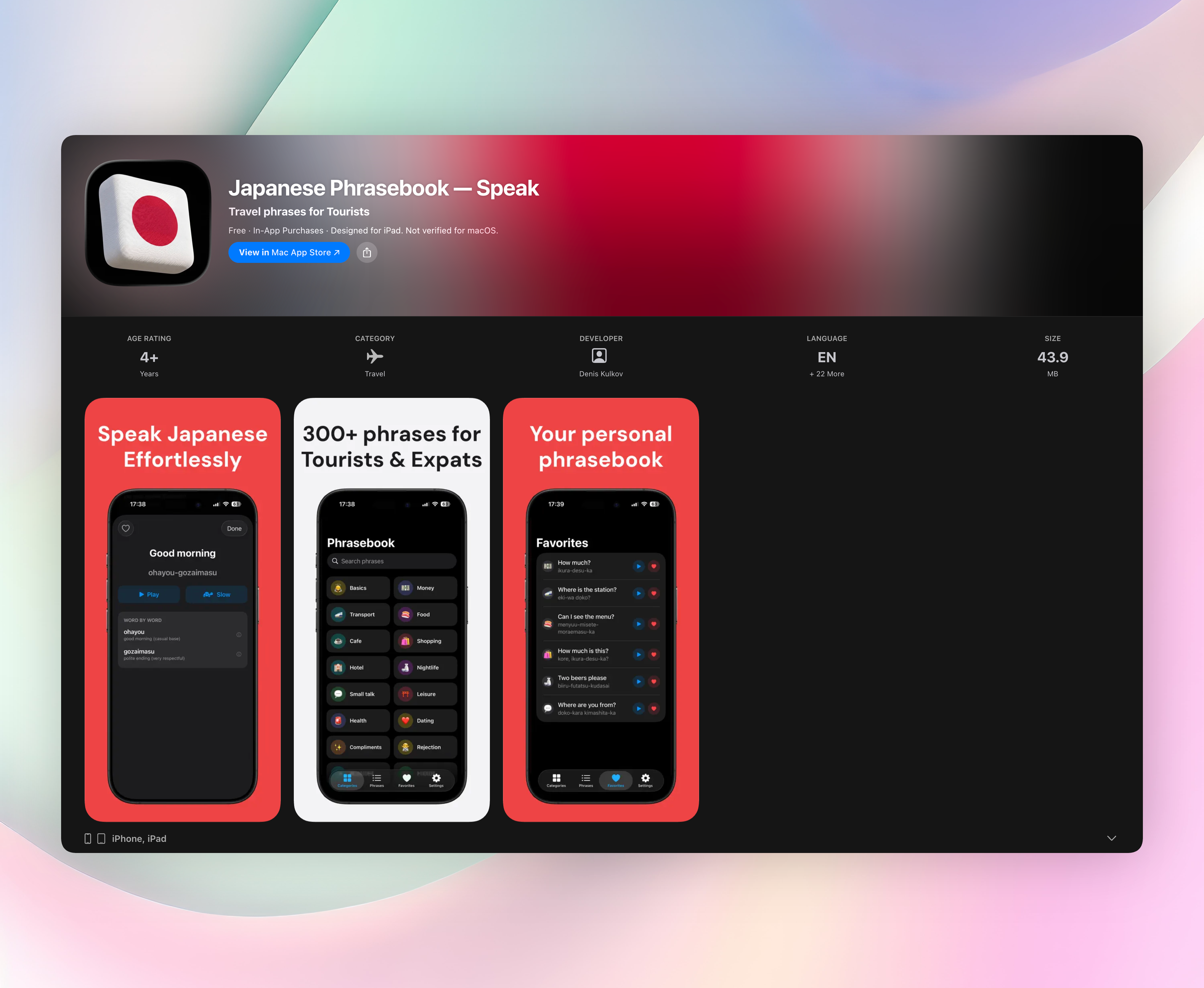
1. Japanese Phrasebook: Speak
Best for: picking up the exact phrases you’ll use at the airport, konbini, or hotel, with natural native audio and no grammar drills.
Japanese Phrasebook is our top recommendation because it’s built for one thing: getting real-world pronunciation right, fast. You won’t find vocabulary lists, verb conjugation tables, or robotic text‑to‑speech. Instead, every phrase is recorded by a native speaker, and you can loop it at full or slow speed until it sticks. The phrasebook‑style layout groups 16 practical categories (Transport, Food, Shopping, Dating, Small Talk). The right expression is always two taps away.
Everything works offline. No accounts, no logins, no data. You can practice on the plane, in the subway, or in a quiet ryokan with zero connectivity. Favorite any phrase to build a personal cheat sheet you pull up in seconds. The teaching notes break down word‑by‑word nuance, helping you understand what you’re actually saying, not just mimic sounds.
Available on iOS. Get Japanese Phrasebook
Standout features:
- Crisp, clear recordings from native speakers you can loop anytime
- Offline access for practice anywhere
- 16 real‑world categories, no filler lessons
- Slow‑speed playback for tricky phrases
2. Japanese Pronunciation Trainer
Best for: beginners drilling the 50‑sound kana chart through pure repetition.
This app zeroes in on the foundational syllables that make up Japanese. It plays clean audio for each kana character, letting you practice until your production matches the native model. There are no games, no vocabulary lists, no distractions. Just targeted phonetic exercises that build confidence one sound at a time. It’s a solid starting point if you want to nail the basics before tackling full phrases.
3. Lingopanda: Learn Japanese
Best for: learners who want real-time AI pronunciation correction during conversation‑style practice.
Lingopanda’s AI engine listens to your spoken Japanese and gives real‑time corrections on your accent and rhythm. It pushes you through dialogue exercises where you pronounce entire phrases correctly to progress. The interface feels like a chat, so you’re training your mouth and ear in a more natural flow. Android‑only, and the free tier gives you a good taste of the correction technology.
4. Talkpal
Best for: blending instant machine feedback with live native‑speaker video or voice chat.
Talkpal combines speech recognition tech and live human connection. You speak, the app analyzes your accent in real time, then you can jump into a call with a native speaker to test those fixes. That real-time loop (machine correction then natural conversation) helps iron out pronunciation habits quickly. It’s iOS‑only and freemium, with paid plans unlocking more talk time.
5. JA Sensei: Learn Japanese JLPT
Best for: learners who refuse to hear a single synthesized voice in their study.
Every audio clip in JA Sensei (vocabulary, phrasebooks, dialogues) is recorded by a native Japanese speaker. No text‑to‑speech engine anywhere. That guarantee means your ear never picks up unnatural intonation. Android‑only, it also covers JLPT prep, but the pronunciation advantage is the real draw: you’re always imitating a human voice.
6. Yomiwa - Japanese Dictionary
Best for: instant native pronunciation of any word or example sentence you look up.
Yomiwa is a smart dictionary first, but its speak function turns it into a handy pronunciation tool. Stumble on an unfamiliar kanji or phrase? Tap the audio icon and hear it spoken naturally, in context. iOS‑only, it works offline once you download the data. It’s the app you open when you think “how do I really say that?”
7. MTL Learn Japanese Words
Best for: training your ear and speaking rhythm through topic‑based listening exercises.
MTL Learn Japanese Words takes a listening‑centric approach designed to improve how you speak. Every exercise is themed around everyday topics, like ordering food or asking directions, so you’re practicing the sounds you’ll actually produce in real life. By hearing and repeating, your pronunciation rhythm starts to feel more natural. Android‑only and freemium.
8. Rosetta Stone
Best for: visual learners who want to see their accent match a native speaker’s waveform.
Rosetta Stone’s TruAccent engine listens to your pronunciation and displays a side‑by‑side audio waveform comparison against a native model. You see exactly where your pitch, stress, or rhythm deviates. The immersive, repetitive method can fine‑tune your accent over time. Available on iOS (and other platforms) via subscription, it’s a heavier investment for serious accent work.
How we picked these apps
We filtered out any app that relies mostly on robotic text‑to‑speech for audio. The ones that made the cut all use real native‑speaker recordings or reliable speech recognition. We compared free trials and user reviews to confirm actual pronunciation improvement, not just generic “learn Japanese” features. We also curated for diverse platforms (iOS and Android) and use cases. Some people just need travel phrases, others want to drill individual sounds, and a few want live feedback. We tested each app ourselves to verify audio quality and feedback accuracy before recommending it.
Frequently asked questions
Can I really improve my Japanese pronunciation with just an app?
Yes, especially with apps that offer native audio loops like Japanese Phrasebook. An app trains your ear and gives you a controlled space to repeat sounds correctly. Pairing that with real conversation speeds things up, but solo practice fixes many common errors like vowel length and pitch accents.
Do I need a pronunciation‑specific app, or will a general Japanese learning app work?
General apps can help, but many still use synthesized voices that lack natural intonation. A dedicated pronunciation app gives you clearer native models and more focused practice, so you build better speaking habits faster than you would in a broad vocabulary app.
Are these apps suitable for absolute beginners?
Several are built for zero‑knowledge starters. Japanese Pronunciation Trainer and JA Sensei start from the kana chart. Even Japanese Phrasebook works for beginners. You don’t need to read hiragana to tap, hear “toire wa doko desu ka?”, and start using it.
The verdict
Japanese Phrasebook is the best all‑rounder for learning understandable, natural Japanese pronunciation quickly. It skips the fluff, delivers crisp native audio, and works offline so you can practice anywhere. If you want to sound more natural from day one without drills or textbooks, start here. Get Japanese Phrasebook
Related reviews
Best 9 Chinese Pronunciation Apps in 2026: Speak Like a Native
We compare 9 chinese pronunciation apps across iOS, Android, and web, evaluating tone accuracy feedback, speech recognition quality, and lesson structure.

Best 9 Japanese Travel Phrases Apps in 2026: Speak Like a Local
We compare 9 Japanese travel phrases apps across iOS and Android, evaluating offline support, pronunciation guides, and phrasebook depth for your next trip.
Best 9 Japanese Tourist Phrases Apps in 2026: Speak Like a Local
We compare 9 apps for learning Japanese tourist phrases, evaluating offline access, pronunciation guides, cultural tips, and platform support for travelers.