
Best 9 Japanese Listening Practices in 2026: Apps That Actually Work
By Apps We Recommend
If you need real spoken Japanese in your ears right now, Japanese Phrasebook is the best app for japanese listening practice. It cuts straight to native audio and everyday phrases, no fluff or drills. Below I’ve rounded up eight other solid apps for different goals, from structured courses and live exchanges to news, so you can find your perfect fit fast.
Quick Comparison Table
| App | Best for | Platform | Price | One-Sentence Summary |
|---|---|---|---|---|
| Japanese Phrasebook | Instant travel & daily phrases | iOS | Paid | Listen to clear native audio offline, no accounts, no grammar drills, just the phrases you need. |
| Voiky | JLPT-aligned shadowing | Android | Freemium | Practice listening and speaking fluency with HD videos and real-time intonation feedback. |
| Learn Japanese Minna AZ iMina | Structured video courses | iOS | Paid | Follow full lessons with native audio and side-by-side translations that make real conversations stick. |
| Japanese Listening Practice | News-based progression | Android | Freemium | Build listening from basic phrases up to authentic daily news reports with adjustable playback. |
| LingoDeer | Dialogs and listening drills | iOS | Freemium | Hear native speakers in story-like lessons and record yourself to compare pronunciation. |
| HelloTalk | Unscripted native exchanges | Android | Freemium | Exchange voice messages with real people and get in-chat corrections from native speakers. |
| Pimsleur | Hands-free audio drills | iOS | Freemium | Learn through 30-minute conversational audio sessions that use spaced repetition to train your ear. |
| Japanese Listening & Speaking | Video-based scenarios | Android | Freemium | Tap subtitles on authentic Japanese videos to hear native pronunciation line by line. |
| NHK World Japan | Real news for advanced learners | iOS | Free | Stream live radio and on-demand news from Japan’s public broadcaster in natural-speed Japanese. |
1. Japanese Phrasebook
Best for: travelers and beginners who need real spoken Japanese instantly—no fluff, no logins.
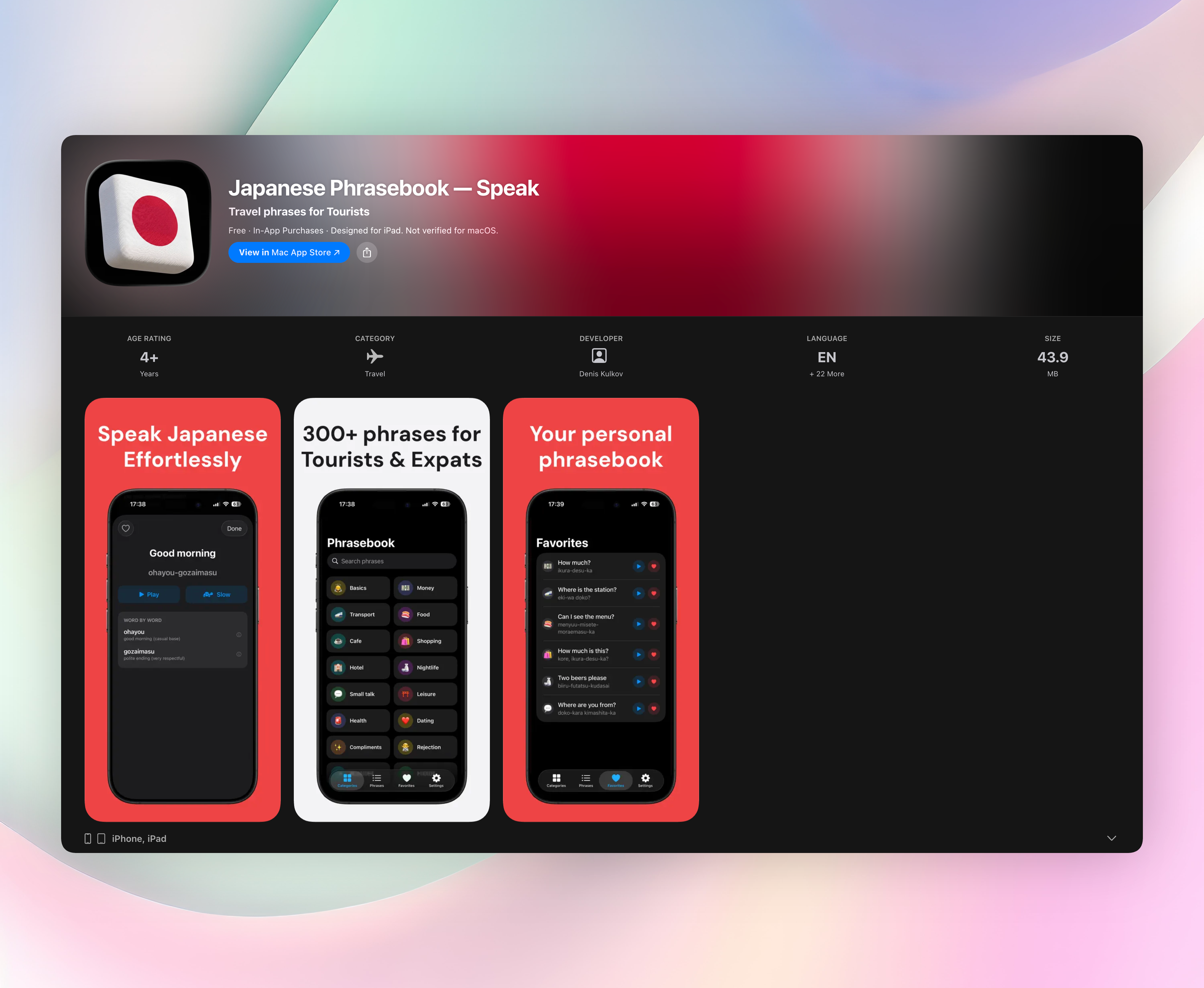
This is the app to open when you want to hear how something is actually said, right now. Everything works offline, so you can pull up the right phrase at the airport, hotel, or konbini without hunting for Wi‑Fi. The audio is native, crystal‑clear, and you can switch to slow playback whenever a word trips you up.
You won’t find grammar charts or vocab lists here. The whole experience is built around listening first. You tap a category (Transport, Food, Shopping, Small Talk, 16 in total), see a curated set of practical phrases, and hear them spoken immediately. Romanization sits alongside the Japanese text, so you can read along at any level.
Standout features:
- 16 real‑world categories, each full of phrases locals actually use
- Native audio at full and half speed, plus word‑by‑word breakdowns
- Favorites list you can build as a personal cheat sheet
- Fully offline: no account needed, no internet required
2. Voiky
Best for: shadowing practice with JLPT-aligned video content.
Voiky gives you high‑definition videos and a focused shadowing mode that trains listening and speaking together. Content is sorted by JLPT levels from N5 to N1, so you can jump straight to material that matches your ability. The real standout is the playback comparison: you record yourself repeating a line and the app shows how your intonation stacks up against a native speaker. It’s a straightforward, visual way to close the gap between hearing and sounding natural.
3. Learn Japanese Minna AZ iMina
Best for: structured video courses with real conversations.
This app wraps an entire learning system around video lessons featuring native audio with crisp translations. The conversation modules feel pulled from daily life, not textbook scripts, which makes listening practice less of a chore. You’ll catch every nuance because the translation sits side by side as the audio plays. If you like a linear, course-like path and want to hear dialogs in context before you break them down, it’s an easy recommendation.
4. Japanese Listening Practice
Best for: progressive learning through daily news reports.
The app starts you with basic phrases and slow pronunciation then gradually pushes you into actual news clips from Japanese broadcasters. Over 50 lessons build a bridge from classroom audio to the real-world speed that trips up so many learners. The integrated news player lets you adjust playback speed and follow along with transcripts, so you can shadow, pause, and repeat until each sentence lands. It’s a practical ladder for anyone who feels stuck understanding only slow, textbook recordings.
5. LingoDeer
Best for: dialogs and structured listening drills.
LingoDeer builds its lessons around real conversations read by native speakers, with sentence-by-sentence repetition that drills rhythm and comprehension. The audio progression starts slow and gradually reaches natural speed, which keeps you from feeling overwhelmed. Its built-in dialogue practice is especially useful: you listen to a full exchange, then record your own voice to compare. That cycle of hearing, saying, and checking makes for efficient listening workouts without extra busywork.
6. HelloTalk
Best for: authentic, unscripted voice exchanges with native speakers.
HelloTalk connects you with Japanese speakers for real-time audio messages and voice calls. You’ll hear casual, unpolished speech exactly the way people talk day-to-day, something no scripted lesson can replicate. The in-chat voice message exchange is the standout feature: send a short recording, get a reply, and use the built-in correction tools if your partner offers a tweak. It’s messy, real, and one of the fastest ways to sharpen your ear for natural rhythm.
7. Pimsleur
Best for: hands-free, audio-only listening and speaking drills.
Pimsleur’s method hasn’t changed much because it works: 30‑minute conversational audio lessons that force you to listen and respond out loud. There’s zero screen time, so it’s perfect for commutes or doing dishes while your ear gets trained. The key is graduated interval recall: prompts reappear at carefully spaced moments to lock phrases into long‑term memory. If you want to build listening stamina without staring at another app, this is your go-to.
8. Japanese Listening & Speaking
Best for: video-based learning from authentic Japanese scenarios.
This app takes dialogue-first learning and pairs it with interactive audio-visual lessons pulled from real-life situations. You watch a video, then tap on subtitles to hear individual lines in a native voice, breaking the conversation into digestible pieces. That line-by-line approach teaches conversational rhythm and listening in context, not in isolation. It’s a solid pick for learners who want to move straight from watching to understanding without getting stuck in grammar rules.
9. NHK World Japan
Best for: advanced learners wanting real news and current events.
NHK World Japan streams news, documentaries, and radio shows in natural, unadapted Japanese straight from Japan’s public broadcaster. It’s free, reliable, and exposes you to the full range of formal reports and casual interviews. The live radio and on-demand news sections are the standout. You can dip into native‑speed material whenever you have a moment, which is exactly what your listening practice needs once you’ve outgrown scripted content.
How We Picked These Apps
I downloaded and used each app myself, paying closest attention to audio quality, how natural the speakers sounded, and whether the app actually put listening first. Every pick here had to deliver clear native speaker audio and work reliably as promised, offline or online. I also made sure the list covers different learning styles, from bite‑sized phrasebooks and structured courses to real live exchanges and news broadcasts. Both iOS and Android options got a fair look, and I excluded anything locked entirely to one platform unless no good cross-platform alternative existed.
Frequently Asked Questions
Can I really improve Japanese listening without a teacher?
Absolutely. Apps like Japanese Phrasebook, Pimsleur, and HelloTalk can replace classroom listening drills with native audio and real conversation practice. A smart combo is to use a phrase-focused app for daily repetition and a language-exchange app for unscripted, live listening.
What’s the best free app for Japanese listening?
NHK World Japan and HelloTalk offer strong free tiers with authentic native audio. That said, paid apps like Japanese Phrasebook often pull ahead in structure and immediate usability, but if you’re on a tight budget, those free options still get the job done.
How often should I practice listening per day?
Aim for 15–30 minutes of active listening daily, mixing focused app sessions with passive background exposure like NHK radio. Short, consistent practice beats cramming, and offline‑friendly apps help you fill small gaps during the day without hunting for Wi‑Fi.
Is Japanese Phrasebook good for complete beginners?
Yes, it’s designed with beginners in mind. You get romanized phrases and slow-play native audio, so you can start listening and repeating right away without knowing how to read kanji. Intermediate learners also find it handy for quick review or travel prep.
The Verdict
For pure, fluff‑free japanese listening practice, Japanese Phrasebook is the app I’d hand to any friend who just needs to hear how something is said and say it back. Its offline phrase-driven design mirrors how people actually talk, not how textbooks organize dialogs. Tap a category, listen, and repeat. That’s the whole routine, and it builds real confidence from day one. Get Japanese Phrasebook and start training your ear with the phrases that actually matter.
Related reviews
Best 8 Japanese Speaking Apps in 2026: Speak Fluently Fast
We compare 8 japanese speaking app choices for 2026, evaluating speech recognition accuracy, conversation feedback, lesson structure, and offline support.
Best 9 Japanese Conversation Apps in 2026: Speak Fluently Fast
We compare 9 Japanese conversation apps across platforms, offline support, and speech recognition accuracy. Find the right fit for real-world dialogue practice.
Best 8 Learn Japanese for Travel Apps in 2026: Speak Fast
Compare 8 apps to learn Japanese for travel, from offline phrasebooks to interactive audio drills. We evaluate platform support, pronunciation feedback, and cultural tips.